Every pillar, every alignment, every trace of erosion is a voice of the Earth that rolled. We are listening.
The simplest explanation: it was their North
Rather than being surprised that civilizations separated by thousands of kilometres and millennia all developed identical astronomical knowledge…
… let us simply ask ourselves:
“What if the point toward which all these monuments converge…
was simply their North at the time?”
The most obvious North, the easiest to identify in a single night of observation. The one around which the Sun rose and set, around which the stars turned.
In that case, any human group, wherever they were on the planet, could align their sanctuary, tomb or observatory toward this new north without needing maps, complex calculations or contact with other peoples.
It is the simplest explanation, the least miraculous… and therefore the most probable.
Celestial alignments or alignments on Np’?
Of course, many monuments are also interpreted as being oriented toward constellations (Sphinx facing Leo), solstice sunrises (Stonehenge) or precession of the equinoxes.
These classical interpretations are not incompatible with the ECDO hypothesis. During State 2, the geographic north had changed, so the entire sky appeared shifted. What we see today as a stellar or solstitial alignment may in reality have corresponded to the new terrestrial north visible at the time.
The two approaches can coexist: some alignments were probably both geographic (Np’) and celestial.
Göbekli Tepe – Pillar 43 (Vulture Stone)
Around 9600 BC, just after the cataclysm according to ECDO, the builders of Göbekli Tepe carved on Pillar 43 a precise map of the northern sky as it appeared before the Great Roll (~14,800 BC).
The vulture holds the Sun in its talons. The "H" symbols indicate the azimuths of sunrise and sunset before and after the cataclysm. The scorpion and the birds encode the constellations and the point of impact of the shift.
Interpretation by The Ethical Skeptic (ECDO) – consistent with the astronomical data and the timing of the Younger Dryas. (Note: alternative interpretation, widely debated in classical archaeology.)
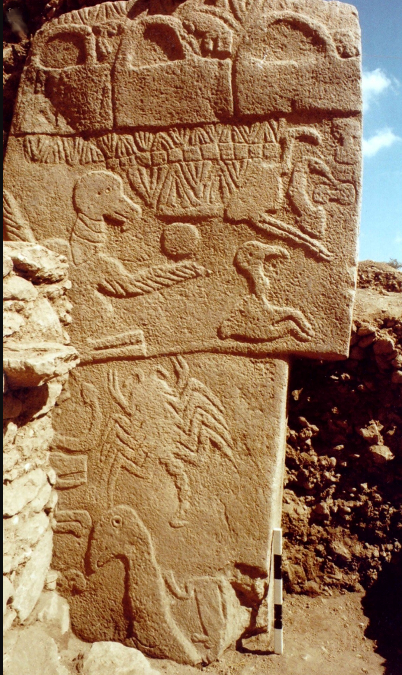
Click to enlarge • Pillar 43 (Vulture Stone)
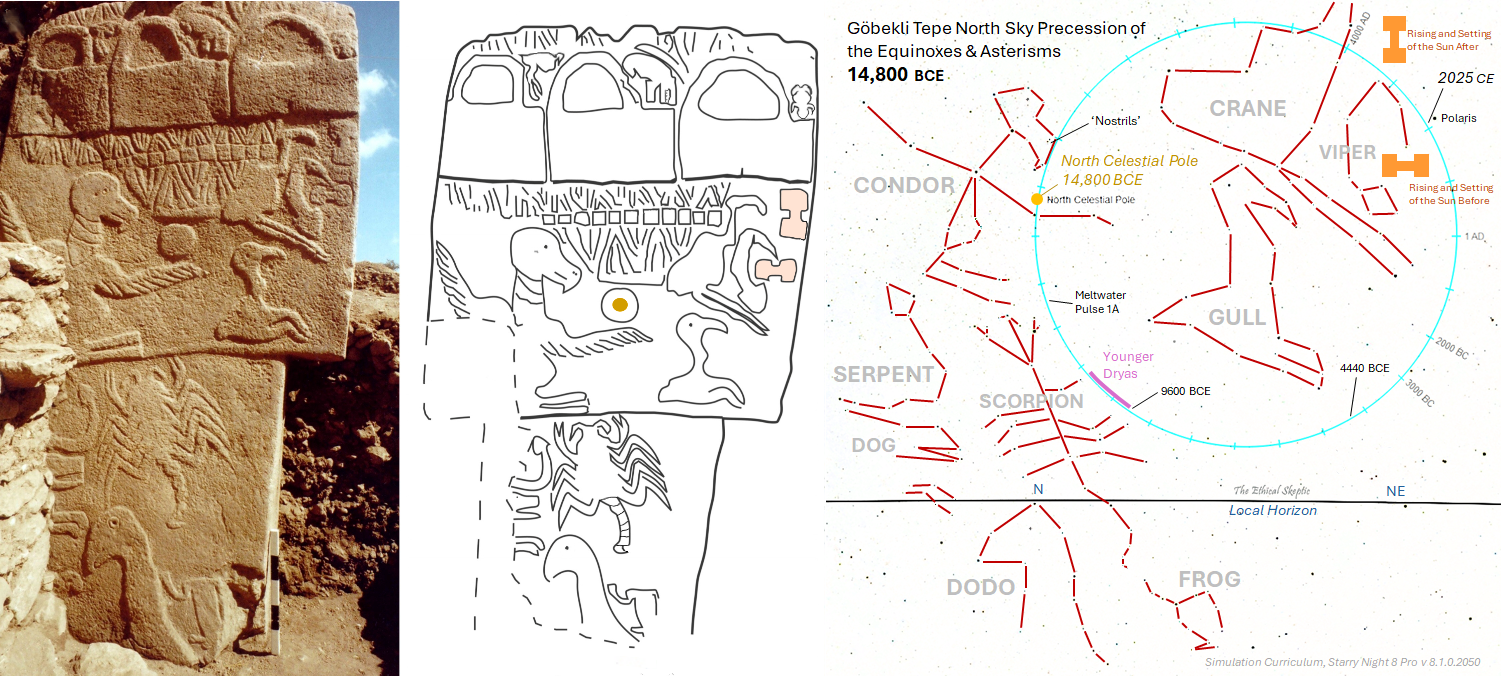
Click to enlarge • Astronomical interpretation of Pillar 43
The Spirals of Ġgantija (Malta)
In the southern temple of Ġgantija (~3600 BC), several stones bear magnificent double or triple spirals, often associated with serpentine motifs.
According to the ECDO interpretation, these spirals are not mere ornaments: they symbolize the rotational movement of the Earth during the Great Cataclysm, or the energy vortices created by the change of axis.
Ġgantija is also one of the temples aligned with Np'. The spirals thus become a powerful memorial marker: "The Earth rolled, we carved it in stone."
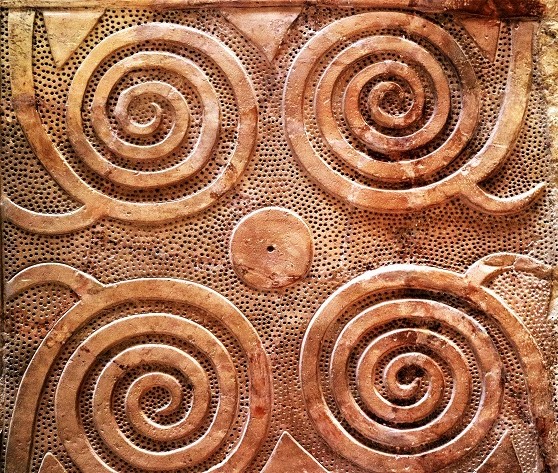
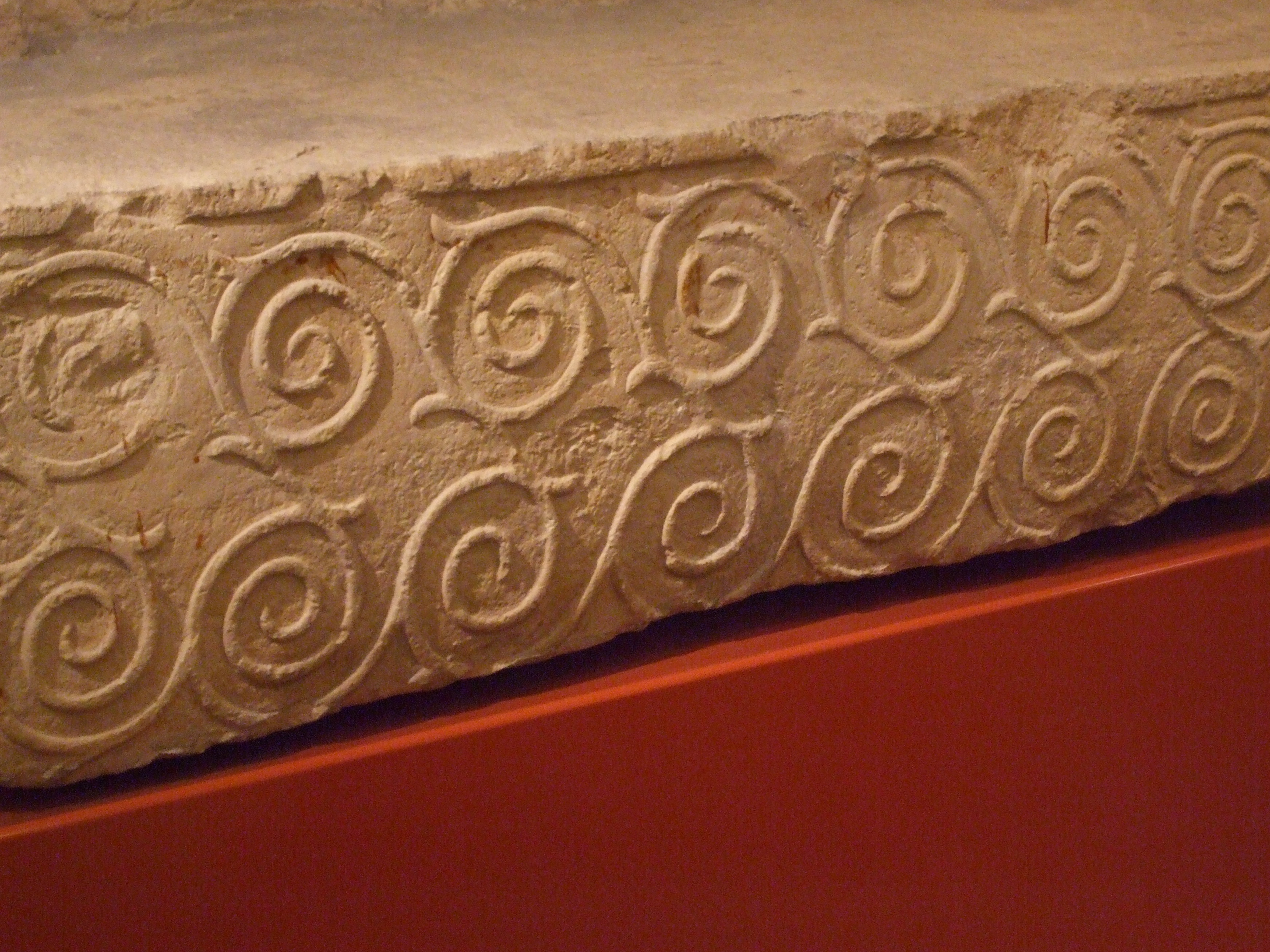
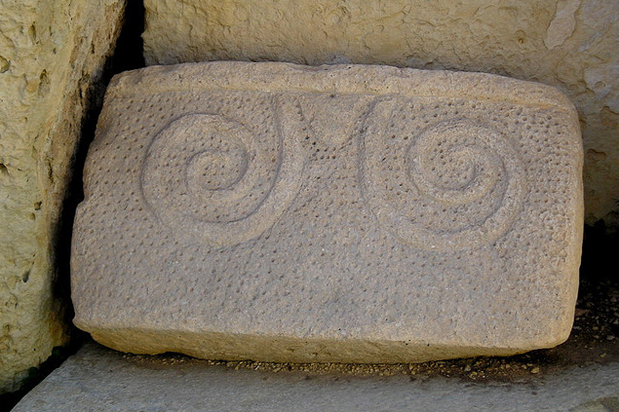
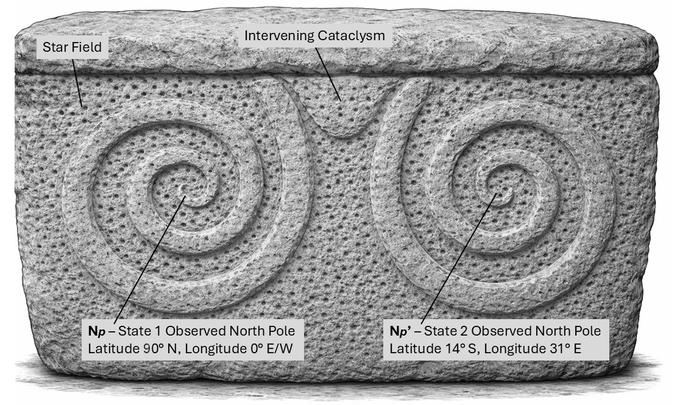
Click to enlarge • Astronomical interpretation of the Ġgantija Spirals
Alignments on Np’ – The Ancient North Pole (State 2)
After the 104° gyroscopic shift, the new geographic pole position (Np’ ≈ 14°S, 31°E, near the Zambia/Malawi border) becomes the new “sacred north”. More than 200 monuments worldwide show a remarkable obedience to this ancient axis.
Hover over clusters or click on markers • Data from ECDO surveys (The Ethical Skeptic and community)
How do we know a monument is aligned on Np’?
We do not draw an imaginary line at random. We identify the main axis of the monument: the one the builders clearly intended to privilege.
| Monument Type | How do we determine the main axis? | Why this axis and not the opposite? |
|---|---|---|
| Pyramid (Giza…) | Axis of symmetry + entrance face + valley temple | The pyramid has an obvious “front face” |
| Egyptian Temple | Longitudinal axis entrance → most sacred sanctuary | The ritual path always goes from public to god |
| Göbekli Tepe / Karahan Tepe | Direction the T-pillars “face” + axis of the enclosures | The pillars have a clearly oriented anthropomorphic face |
| Maltese Temple (Ġgantija) | Axis of the main chamber + entrance stones | Clover-shaped plan with unique entrance |
| Sacsayhuamán, Puma Punku… | Axis of symmetry of the walls + access ramps | Asymmetrical architecture with obvious direction of movement |
A single line passes through an infinite number of points… but here we have more than 200 independent monuments. When we extend all these axes, they all converge toward a single point: Np’ (14°S, 31°E).
It is a collective obedience to a new geographic north during a transitional period.”
It is not a line.
It is a beam.
Evidence of Massive Ocean Displacement
Beyond the alignments of ancient monuments, numerous independent geological traces confirm a rapid and recent shift of the Earth's crust.
Craig Stone's Analysis (nobulart.com)
Craig Stone has studied over 2,500 sites worldwide. He has identified sedimentation directions, slump structures, and erosion patterns consistent with a rapid pole shift of approximately 104°. These findings are difficult to explain through slow, uniformitarian processes.
Marine Fossils in the Sahara
Recent marine fossils (seashells, corals, whale skeletons) are found deep in the Sahara Desert, sometimes at hundreds of meters above sea level. These remains indicate that vast regions were submerged relatively recently.
The Rub'al Khali (Saudi Arabia)
One of the largest deserts in the world contains enormous salt deposits and evaporites. Analyses show it was once an inland sea that was suddenly drained, likely during a crustal shift that dramatically altered ocean distribution.
Marine Erosion on the Pyramids and the Sphinx
Clear signs of water erosion are visible on the Sphinx and the Giza Pyramids at heights incompatible with current sea levels. These saltwater marks suggest that the Giza region was submerged after the monuments were built.
These geological clues are not isolated: they converge with the alignments of megalithic structures toward the former North Pole (Np’). The Earth did not just move slowly… it rolled.
Dates and superposition: why the alignment persists over millennia
Many monuments have very spread-out “official” dates. Göbekli Tepe ~9600 BC, the pyramids ~2580 BC, Tiwanaku ~500 AD…
Two explanations that reinforce each other:
- 1. Dating contested by geological evidence
Several sites show traces of prolonged marine submersion. According to ECDO, these monuments (or their foundations) date from State 2. - 2. Voluntary superposition
Later civilizations often built over older megalithic foundations while preserving the original axis toward Np’.
“It is not just an alignment.
It is a sacred tradition that transcends cataclysms and civilizations.”
- The Ethical Skeptic
The alignment on Np’ does not stop with the return to State 1. It becomes a memorial marker.
Why were they able to build so quickly?
It is the question every critical mind asks – and we ask it too.
According to ECDO theory
State 2 (pole fixed on Np’) lasts 50 to 400 years.
This is enough for organized survivors to transmit knowledge and erect sacred markers over 2 to 10 generations.
The motivation is not “royal prestige”: it is memorial survival.
“The Earth rolled. We carve the new North so that our children know.”
— Randall Carlson, JRE
Here, State 2 offers a window of relative stability after the chaos. The Ancients do not wait for the “perfect civilisation”: they act because the sky itself has changed.